Sunday, 15 August 2010

FYI: QCI Savannah Meeting Attendees.

If you are planning on coming to the QCI meeting in Savannah this October why not set aside some time either before or after the meeting to discover the nearby town of Beaufort?
Barely 40 miles north of Savannah, Beaufort is a delightful little waterside town of about 12,000 people.
Scads of movies have been made there; Forest Gump, The Big Chill and The Prince of Tides.
It’s easy to see why.
The town, sits snugly on the Intracoastal Waterway and is one South Carolina’s low country gems.
Few small towns in the States can compete with Beaufort’s abundance of antebellum mansions.
A stroll down some of the neighborhood streets, lined with trees draped with Spanish moss, is a real treat.

You could check out the Greek Revival manse, take a buggy ride through the historic district, and visit the Penn Center Museum, the first school for freed slaves after the Civil War.

The Beaufort Arsenal was the home of the Beaufort Volunteer Artillery, which traced its formation to an earlier company organized in 1776 and served in the Revolutionary War. The BVA was stationed at Fort Beauregard during the Battle of Port Royal on November 7, 1861.
If you have time consider joining Jon Sharp for his wonderful Historical Walking Tour.

A myriad of inlets and waterways offer great fishing and boating, the beaches of Hunting Island are vast and walkable in October.
For those of you who enjoy birding, there are a myriad of species of sea birds in the area.
With wonderful places to eat and stay, a visit to Beaufort would be well worth your while.
For more information visit the Beaufort County Visitors Website by clicking  here.

Friday, 13 August 2010

Ardingly Antiques Fair, Sussex.......by Louise R

Towards the end of July we spent an exhausting but fun day out at one of Southern England's largest antique fairs held in Ardingly, Sussex.
It is held at the County Showground, both indoors and out. Thousands of stalls and traders from all over Europe as well as local dealers and buyers.
I really recommend this fair, the next ones are on the 7th September and 26th October.
Fortunately it was a lovely day, we started at 10 and it took us about five hours to cover the entire site, with vital stops for food and drink and a chance to sit down for a minute!
The first thing I saw was an old Malicorne platter, It was inexpensive, but I couldn't decide, I wasn't quite sure about it. As I hovered, another buyer grabbed it and bought it! Ah well!
We then came across a large Dutch gentleman with a huge amount of Quimper spread out on blankets on the ground.
He said he'd bought up an entire collection and we got quite excited for a moment, but on further inspection a lot of it was damaged or just odds and ends.

Still, I got to practise my rather rusty Dutch on him and I did buy two things, a completely silly,very pink, early Keraluc candlestick which I love, and a nice blue HB Modern Movement shrimp dish.

Later on we found two plates (No, not more plates!).
An HB croisille with Breton and an earlyish HB with a rather nice swan on it.

These were so cheap it seemed silly not to buy them. Ah, I can hear you all sighing, we've all been there!

Bryan bought some old toys (second childhood!), as we are going to trade at the next Alexandra Palace, London, fair in September and we need lots of assorted treasures to entice the buyers.
I might put some Quimper on the stall if I can bear to part with it! Its a local fair for us, so easy to get to, do drop in if you're in London.
We will head for France in October when all the schools are back.
We haven't been for over a year due to Bryan's health so, I can't wait to see Bretagne again. I've been keeping up my French classes, its so easy to lose a language if you don't hear it spoken.
I wish I could find someone to do ceramic restoration in this country, Quimper is quite specialist and here they just seem to do porcelain repairs.
Sending it to France is not easy and risks damage, if anyone knows someone do let me know.

Monday, 9 August 2010

Faïence Creatures Great and Small....We Collectors Love Them All.....by Cerélle


Faïence Creatures Great and Small....We Collectors Love Them All.....by Cerélle

Or so it seems, by the great variety of animals that one can find. All of the faïence centers seem to have made them - Quimper, Malicorne, Desvres, Moustiers, and others. Perhaps the makers liked them as much as we do.

First represented are the family pets, our beloved dogs and cats who enrich our lives.

They are found in figurine form as well as painted on plates and vases and little bells and other details such as the poignées on the lids of jars or tureens.


This little pitcher was made in Malicorne, and with his
soulful eyes and long ears, seems to me to be a spaniel.


Recently I purchased an early CA plate which really delights me. It shows a peddler selling puppies on the promenade alongside the Seine River in Paris. Behind him can be seen Notre Dame Cathedral, and the sky is dotted with those trademark fluffy white clouds.

He is holding the presumed mother of these pups, and one puppy is being held out while two others are seen peeking out of his pockets.
Oh, dear..I would have wanted ALL of them and the mother, too.
Of likely more recent production is a covered box with a happy reclining Golden Retriever on the lid. This is marked "Hand Painted in France for Tiffany and Co E III AP" This is reminiscent of pieces made for them in Quimper, but the decoration is more in the style of Desvres to my mind. Wherever it was produced, I find it quite charming.


Knowing our love for Poodles... you can imagine my joy at finding a Delft dog, which I believe to be a poodle. Certainly no other dog is shown with a pom-pom tail like this!


And I have a marvelous Malicorne plaque showing a lady holding a sock which her poodle thinks is for him. He isn't groomed "to show", but then neither is mine, and this would have been long ago too.
Look at the grooming, or lack thereof, in this marvelous old photograph of a poodle family. I like to consider it a photo of our Chouette's ancestors!

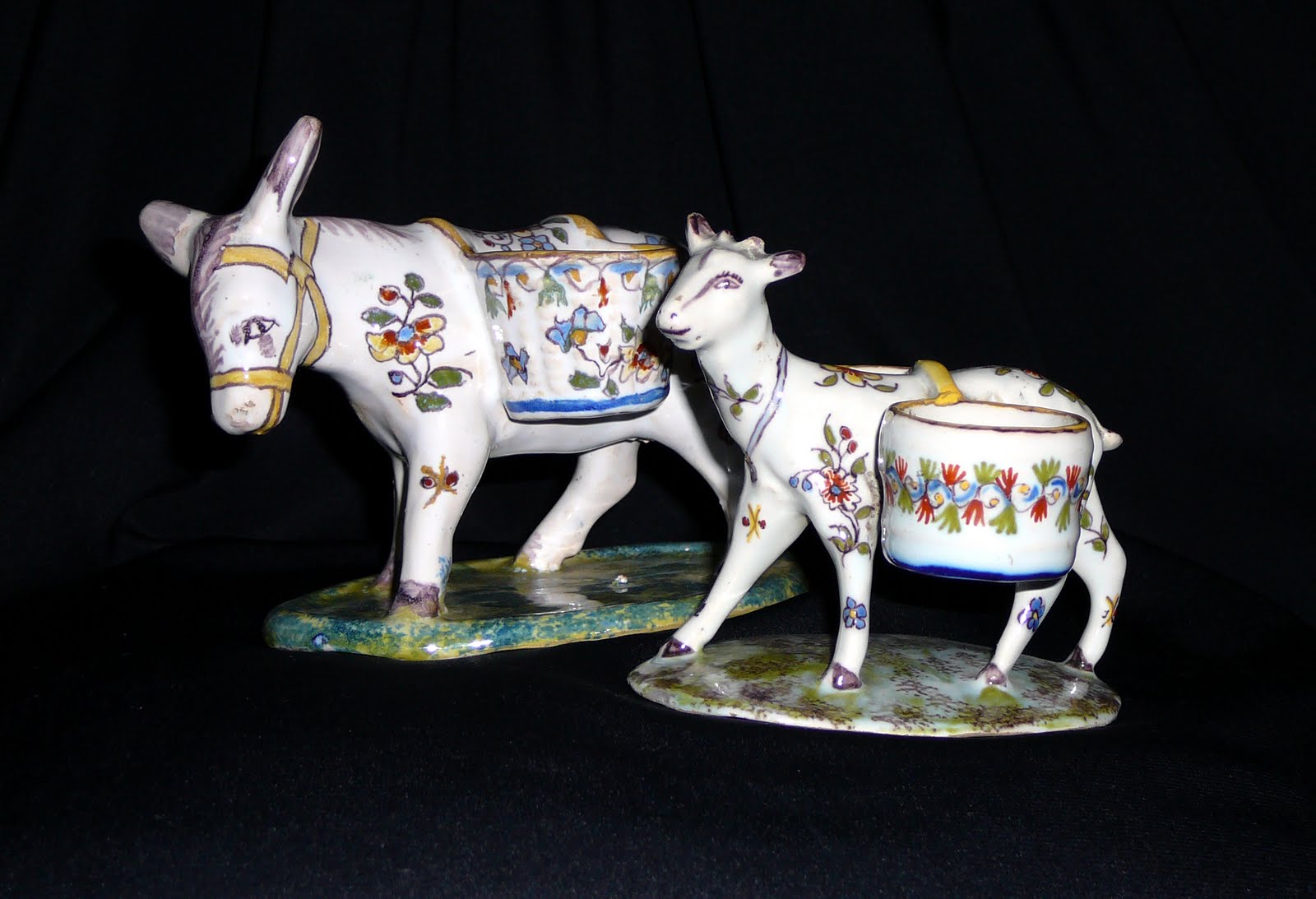
Next, there are the domesticated animals such as donkeys and goats, which seem to appear mostly as beasts of burden carrying a pair of baskets. These are salts, and this makes them doubly collectible. Both of the ones shown are from Desvres. These are Fourmaintraux Freres production and I am fond of the soft Manganese purple colors and their facial expressions.


Horses appear but not so often. These are candleholders, and as you can see I like to use a set that is not exactly matched, as I do for my dishes. These are HB Quimper and HB-Henriot.
And then, too, our little creatures "tuck in" most anywhere and always bring a smile.
There are many others to be found, pigs are especially popular, but whichever ones catch your eye, they are fun to search for and a joy to collect.

Thursday, 5 August 2010

Bannette with a story.........by Cerelle B

Malicorne faïence has always been a favorite of mine. Just as Quimper has its own charm and individuality, so has Malicorne.
Malicorne, like Quimper, is a town of course, and in Malicorne there were numerous faïenceries starting from the mid 1700s.
The banette in this blog was made by the Pouplard-Béatrix liaison of Plat d'étain. The number of faïenceries has greatly declined, but there are still active ones there making beautiful things and there is a museum worthy of the trip for lovers of faïence.

Being a hopeful gardener, I have always liked bees. I love having them buzzing around the garden, knowing they are busy doing their pollinating jobs. For that reason, I feel protective of them and several times I have used a twig to fish an errant bee out of the birdbath before he drowns.
So it was with delight that recently I saw on sale a Malicorne banette featuring a scene with bees. Now this was a first for me! I am especially fond of the Pouplard painted Malicorne pieces, but never before had I seen anything like this.


PBx mark on the back of the banette.
It is a busy scene with seven people ranging in all ages. A younger man is showing an elder what is going on. Some of the people, including a young girl, are wielding strange instruments or tools of some sort.
My husband, Bill, who had helped his grandfather tend the beehives on the ranch, did not recognize the devices. He said that they had used smoke to calm or daze the bees when they would harvest the honey, but that these surely didn't look like smokers.
After much puzzling and conjecture, I searched the Web and who knew there would be so much on bee keeping?!
I came upon a site John's Beekeeping Notebook which had all kinds of information on bees, as well as other topics, and an address to contact.
I wrote to John and presented my questions about the scene. He kindly replied that it appeared the people were doing what was called "drumming" or "tanging" the bees.
I found this fascinating picture from a late 17th century Dutch book.
The object in the man's hand looks very much like the ones people are shown using on my banette.
The book stated that "Tanging was also a way for a beekeeper to alert other beekeepers that a claim was being made on a found swarm. Acquiring new bees by laying claim to a swarm was important, as it was routine at this time for beekeepers to asphyxiate their bees with fumes from burning sulphur in order to access the honeycomb safely.”
Oh dear! Poor hardworking bees!
This is evidently a very old technique to get a swarm of bees to stop flying and settle down. This is hardly ever used today, according to John, but getting a free swarm to settle into a skep (or skip, as the straw hives were called) was the primary way for a beekeeper to increase his number of hives.
He said, "Today, we raise queens when we want to increase our number of colonies."
Bill was amazed, and said that in his experience making all that noise would only anger the bees. However, he stated, they had been working with resident bees, not ones free and searching for a spot to settle and live.
John referred me to other sites. Beesource.com and Bee Lore.com
On Bee Source, there was an interesting discussion of drumming the bees and there were some great stories of firsthand experiences doing that.
So, it appears that they are not concerned that it will anger the bees. Surely the elder persons would not be so close, nor that young girl either, if that were so.
From my first view of it, I have loved the painting on this platter showing this unusual scene and all of the interested and involved people and now that I know what they are doing, it means so much more to me.

Monday, 2 August 2010

Hot Summer Days......meet our August Bloggers.

This month we have three QCI Members sharing blog duties.
Cerelle B, one of the guest speakers at our upcoming meeting in Savannah, is back again for another stint and she will be joined by well know Quimper expert and author Sandra Bondhus, and Louise R will be reporting from the British Antique's Fair scene.
We're starting the ball rolling with this lightheated look at Quimper pieces sure to bring a smile to everyone's face.
To spread the sunshine I'll be linking this post to Mosaic Monday graciously hosted by Mary @thelittleredhouse.
If you have time, do visit Mary and discover beautiful collages from around the world.
The plate below is from the Long collection. All other items are from Sandra's collection.

Maggie


Here is Sandra's first blog:

As the August days of summer spread their glowing warmth over the golden coast of Brittany, it recalls to mind the coastal beaches with sunlight dancing on the ocean waves.
One can feel the warmth of the white sand both caressing and soothing as one strolls along the Breton beaches. The sun is the cause of this blissful summer respite.
The sun is also the symbol of light, warmth, and life, in both the Celtic and Christian traditions.
Both of these traditions strongly influence the culture of the region.

Is it any wonder then that we find the symbol of the sun painted with such a “joie de vivre” on many of the “faience populaire” pieces of Quimper?
I have always been attracted to this decor. There is something which simply brings a smile to the lips when looking at these delightfully rendered naive pieces.


I have found them on plates, chargers, covered mugs and snuff bottles. On every divergent form the little sun face seems to tug at the corners of my heart and coaxes me into a joyful smile.
It is a “Smile of Brittany”, which is reflected in the playful charm of this pattern.
Please allow me to share some summer smiles with you through the photos on this blog.


Come and allow me to invite you to stroll along the pleasant shores of Brittany and to vicariously bask in the summer sun through these fanciful faces, which so delightfully adorn these pieces of Quimper faience.


BONNES VACANCES EN BRETAGNE!

Saturday, 31 July 2010

My Last Collection

I have a well-developed appreciation for old Quimper and other French pottery, but at heart, I have a particular fondness for the post-WWII productions, like Keraluc and Ty Breizh and Kercy Quimper.


When I started coming to Quimper 25 years ago, on the rue Saint François, right near the market, there was a shop where a ceramicist named Mme Kercy displayed her wares. I was a fan right away!! The soup plate on the lower right of the above photo is one of the first pieces I ever bought from her, and it was soon followed by the two pieces  below (I actually bought two of the little bowls, but only one remains ... ):


As time went by, Mme Kercy's shop evolved, and it became more of a tourist shop with souvenirs and other items that she did not make, until one day her lease was not renewed and that was the end. By that time, I was living here, and I became more interested in her pieces. On a visit to St. Ouen in Paris, a dealer told me that this piece was from one of the Quimper manufactures in the 1950s:


I said, "oh, really? how interesting", knowing that it was rather more recent than that (Mme Kercy is older than I am, but not that much older!). And by then I hooked. However, these pieces are all put aside as I buy them, and I'm planning on this being my last collection, when the time comes that we have divested ourselves of all the rest of our pottery. It was rather fun taking out pieces to photograph, because I had no idea that I've already collected a fair amount!


Mme Kercy used lots of bright blue and ocher, and her brush stroke is emphatic. I don't know where her biscuit came from - in fact, I don't know much about her at all.

This blue is used with other tones, particularly raspberry and mauve. The covered mug has an insert for tea leaves!

Lots of ceramicists in this area are inspired by Moroccan pottery at times ...

Mme Kercy's signature is at times difficult to read, if you don't know what you are looking for, so on eBay pieces can be attributed to all sorts of names!

Last March, I was at a "stuff" auction (my favorite kind, you may remember). I specifically went to buy this large covered casserole:

On my way out, Mme Kercy spoke to me - it was kind of hard to have a major discussion in the middle of an auction, but she did say that she had a lot of stock left and that in times gone by, she'd had a number of American clients. I used to be a little more on the ball than I apparently am today, because I let a golden opportunity get away from me ... and I have been trying ever since to reach Mme Kercy to talk to her about how we might work together to get back in touch with the American market - I would love to see what she has left and to be able to sell it!!

But Mme Kercy has been very difficult to get hold of, and I understand from someone who would like to write an article about her and her pottery that she is somewhat retiring at this point in her life, although she told me that she likes to go to auctions for the fun of it. However, I did not see her at auctions this summer, and when the school year starts ("La Rentrée" - in France, it's a lot more than back-to-school, it's also back-to-your-normal-workaday-life), I'm going to redouble my efforts to talk to Mme Kercy in person.

In the meantime, I just bought these two plates:


I have been told that Mme Kercy worked for Keraluc at one time, and the designs on these plates would certainly support that theory - I'm hoping to be able to confirm it in person. 

So stay tuned - if I'm successful, I'll ask our blog chief for an opportunity to give you an update! In the meantime, I'm going to go on stashing Mme Kercy's pieces away - it's turning into a super collection!!


Friday, 30 July 2010

1st Anniversary Giveaway: The Rest Of The Story.

To celebrate the QCI blog's first anniversary earlier this year we gave away a beautiful heart shaped pendant necklace, created by Henriot Bijoux.

The winner of this lovely piece of jewellery was Mary @ The Little Red House and this week she blogged about receiving the gift.


You can read about how much she loves it and see more of her stunning photography by clicking here.